Understanding AI Transforming Ideas Into Intelligent Solutions

A good idea rarely becomes useful on its own. It needs structure, testing, feedback, and a way to work in real life. Artificial intelligence helps with that journey. It can turn raw thoughts, messy data, repeated tasks, and human questions into systems that learn, respond, predict, and assist.
AI is no longer limited to research labs or science fiction. It now appears in phone cameras, language translation, bank fraud checks, traffic maps, farm advisories, medical imaging support, customer service chats, and learning apps. The real value is not magic. It is the ability to use data and patterns to solve problems faster and, in many cases, more consistently.
Understanding AI Transforming Ideas Into Intelligent Solutions means looking beyond the buzz. It means asking what problem needs solving, what data is available, how the system should behave, and how people will use it safely.

What AI really means
Artificial intelligence is a broad term for computer systems that perform tasks usually linked with human thinking. These tasks may include recognising images, understanding language, finding patterns, making recommendations, planning routes, or generating text and media.
At its core, AI does not “think” like a person. It processes information based on rules, examples, probabilities, and learned patterns. A simple AI system may follow fixed logic. A more advanced one may learn from large amounts of data and improve its performance over time.
The most common types include:
Machine learning
Systems learn patterns from examples. A bank may use it to flag unusual transactions.
Natural language processing
Systems work with human language. Translation tools, voice assistants, and chatbots use this.
Computer vision
Systems analyse images or video. It can help detect defects in products or read scanned documents.
Generative AI
Systems create text, images, code, audio, or summaries based on learned patterns.
Recommendation systems
Systems suggest what a person may want next, such as a product, film, song, or article.
AI becomes useful when these abilities are tied to a clear goal. A model that can recognise invoices is interesting. A system that reads invoices, checks totals, detects errors, and sends them for approval is a solution.
From idea to intelligent solution
AI projects often start with a simple sentence: “Can we make this easier?” That question may come from a teacher, doctor, farmer, engineer, shop owner, student, or product builder. The idea becomes stronger when it is shaped into a specific problem.
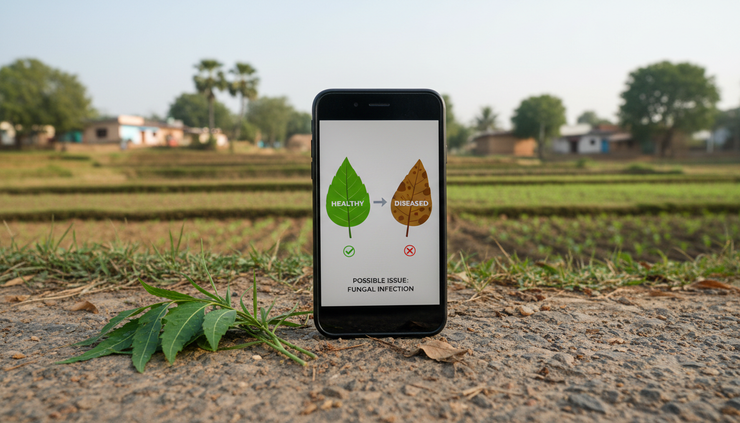
For example, “use AI in agriculture” is too broad. A better problem is, “help farmers identify common crop diseases from leaf photos and suggest the next step in local language.” That version has a user, a task, an input, and a possible output.
A useful AI solution usually follows this path:
Define the problem clearly
The team must know what success looks like. Is the goal to save time, reduce errors, improve access, detect risk, or make information easier to understand?
Collect the right data
AI learns from examples. Poor data leads to poor results. Clean, relevant, and well-labelled data matters more than a fancy model.
Choose the right method
Not every problem needs advanced AI. Some need simple rules, search, automation, or better design. AI should be used where pattern recognition or prediction adds real value.
Build and test the system
Testing should include real-world cases, edge cases, and failure cases. A model that works only in perfect conditions is not ready.
Add human review where needed
Many AI systems should assist people, not replace judgement. This is especially true in health, finance, law, safety, and education.
Improve after launch
User feedback, new data, and changing conditions help refine the system. AI needs care after deployment.
This process keeps the focus on the result, not the technology alone.

Where AI already creates everyday value
AI often works best in places where there is too much information for people to handle manually, or where fast pattern detection can improve decisions.
Better search and discovery
Search engines, shopping platforms, learning apps, and entertainment services use AI to understand intent. The system does not only match exact words. It tries to predict what information or item is most relevant.
For a student searching for NCERT explanations, a good AI-powered tool can separate a basic summary from a detailed concept explanation. For a shopper, it can show more relevant options based on size, budget, and past interest.
Language access
India has many languages and dialects. AI tools can support translation, speech recognition, text-to-speech, and local language summaries. This can help people access digital services even if they are not comfortable with English.
A government information page, for instance, becomes more useful when people can ask questions in their preferred language and receive clear answers.
Safer digital payments
Digital payments have grown quickly across India. AI can help detect unusual transaction patterns. It may flag activity that does not match normal behaviour, such as a sudden high-value transaction from a new location or device.
This does not mean every alert is fraud. It means AI can help focus human attention on cases that need checking.
Healthcare support
AI can assist with tasks such as reading medical images, organising patient records, reminding patients about follow-ups, or helping doctors find relevant information. It should not be treated as a doctor by itself.
In healthcare, AI must be handled carefully. The system must be tested, monitored, and used with professional judgement. The aim is support, not blind trust.
Education and personalised learning
AI can help learners practise at their own pace. It can generate quizzes, explain concepts in simpler language, identify weak areas, and offer study plans.
A student preparing for board exams might use an AI tutor to practise maths problems. The tool can show where the mistake happened instead of only giving the final answer. That feedback can make learning more active.
The ingredients of a strong AI solution
A clever model is only one part of the system. Many AI projects fail because they ignore the basics.
Ingredient | Why it matters |
Clear problem | Keeps the project focused on a real need |
Good data | Gives the model useful examples to learn from |
Human context | Helps the system fit real behaviour and limits |
Simple design | Makes the output easy to understand and use |
Testing | Finds errors before they cause harm |
Security | Protects data and reduces misuse |
Monitoring | Keeps performance stable after launch |
A strong AI solution should feel practical. It should reduce friction, explain its output where possible, and work within the limits of the user’s environment.
For example, an AI tool for small retailers in India should not assume high-end devices, perfect internet, or English-only use. It should work on common smartphones, handle noisy data, and present information in a simple format.
Why data quality decides the outcome
AI learns from data, so data quality shapes system quality. If the data is incomplete, biased, outdated, or poorly labelled, the system may produce weak results.
A face recognition system trained on limited groups may perform unevenly across different skin tones or age groups. A language model trained mostly on formal English may struggle with mixed Hindi-English, Tamil-English, or local expressions. A crop disease model trained only on clean lab images may fail when farmers upload photos in poor lighting.
Good data work includes:
Collecting examples from real use conditions
Removing duplicate and irrelevant records
Labelling data carefully
Checking for bias and gaps
Protecting personal information
Updating data when the world changes
Data also raises ethical questions. People should know when their data is collected, why it is used, and how it is protected. Consent, security, and fairness are not extra features. They are core parts of responsible AI.
Human judgement still matters
AI can process huge amounts of information, but people provide purpose, values, and accountability. Human judgement matters in deciding what to build, what not to build, and when to override a system.
AI can make mistakes. It may misunderstand context, produce false information, reflect bias in training data, or act confidently when uncertain. Generative AI, in particular, can create fluent text that sounds correct but contains errors.
That is why critical review is essential. A teacher should check AI-generated lesson material. A doctor should review AI-supported findings. A legal professional should verify citations and interpretations. A business owner should test automated customer replies before using them widely.
The best systems keep humans in the loop for high-impact decisions. They also make it easy to report mistakes and improve the tool.
AI is most useful when it extends human ability, not when it removes human responsibility.
The role of AI in creativity
AI can support creative work by helping people move from a rough concept to a clearer draft. It can suggest outlines, generate design variations, summarise research, create code snippets, or help test different approaches.
This does not reduce the value of human creativity. The idea, taste, judgement, and final direction still come from people. AI can speed up exploration, but it cannot replace lived experience, cultural sense, emotional understanding, or moral choice.
A filmmaker may use AI to organise footage. A writer may use it to test headline options. A designer may use it to create early visual references. A teacher may use it to build practice worksheets. In each case, AI acts as a collaborator that handles some of the heavy lifting.
The strongest creative use of AI comes from clear prompts, careful review, and personal refinement. A weak prompt produces generic results. A thoughtful prompt, paired with human editing, can turn a rough idea into something useful.
Risks that cannot be ignored
AI brings real benefits, but it also brings risks. Treating it as harmless automation can lead to poor decisions.
Common risks include:
Bias
Systems may treat groups unfairly if training data reflects past inequality or missing representation.
Privacy loss
Sensitive data can be exposed if collection and storage are poorly managed.
Over-reliance
People may accept AI output without checking it.
False information
Generative tools may invent facts, sources, or details.
Job disruption
Some tasks may change or reduce, while new roles appear around AI use, review, and management.
Security misuse
AI can help attackers create phishing messages, fake media, or automated scams.
Responsible AI needs rules, testing, transparency, and awareness. Organisations should explain when AI is being used, protect user data, and identify who is accountable when something goes wrong.
How to start using AI well
The best way to begin is not to chase the newest tool. Start with a real problem that repeats often.
A practical starting point could be:
Pick one task that consumes time or causes errors.
Write down the current process.
Identify the input, such as text, images, forms, or numbers.
Decide what output would help.
Test a small AI tool on sample cases.
Compare the result with human work.
Improve the process before scaling it.
For a school, this might mean creating practice questions from lesson notes. For a clinic, it may mean sorting appointment requests. For a small manufacturer, it may mean checking product images for visible defects. For a retailer, it may mean forecasting demand for common items.
The goal is not to automate everything. The goal is to make one useful process better, then learn from it.

What the future of AI may look like
AI will become more common, more personal, and more deeply connected with everyday tools. Phones, vehicles, appliances, classrooms, farms, hospitals, banks, and public services will keep adding AI features.
The next stage will likely focus on systems that can work across text, voice, image, and video together. A person may show a machine a broken part, describe the issue in a local language, and receive repair guidance. A student may upload a handwritten answer and get feedback on method, not only marks. A doctor may review patient history, scans, and notes through one assisted system.
For India, the big opportunity lies in access. AI can help bridge gaps in language, distance, cost, and expertise. But the benefits will spread only if tools are affordable, inclusive, secure, and easy to use.
Good AI should respect the people it serves. It should explain enough, fail safely, and support better decisions.
The real takeaway
AI turns ideas into intelligent solutions when it is built around real problems, good data, careful design, and human responsibility. The technology can recognise patterns, generate content, predict outcomes, and reduce repeated work. Yet its value depends on how wisely people apply it.
The smartest approach is simple: start small, test honestly, protect users, and keep human judgement at the centre. That is how AI moves from a fascinating concept to a tool that genuinely helps.

Comments